Back to Blog
Successful selling starts with a good product ecosystem
Visual representation of the product ecosystem
The 5 phases of a profitable product ecosystem
Phase 1: Introduction
Phase 2: Lead Generation
Phase 3: Lead product
Phase 4: Main product / Core product
Phase 5: Customer product
Why this system works
In Conclusion
Apr 30, 2026
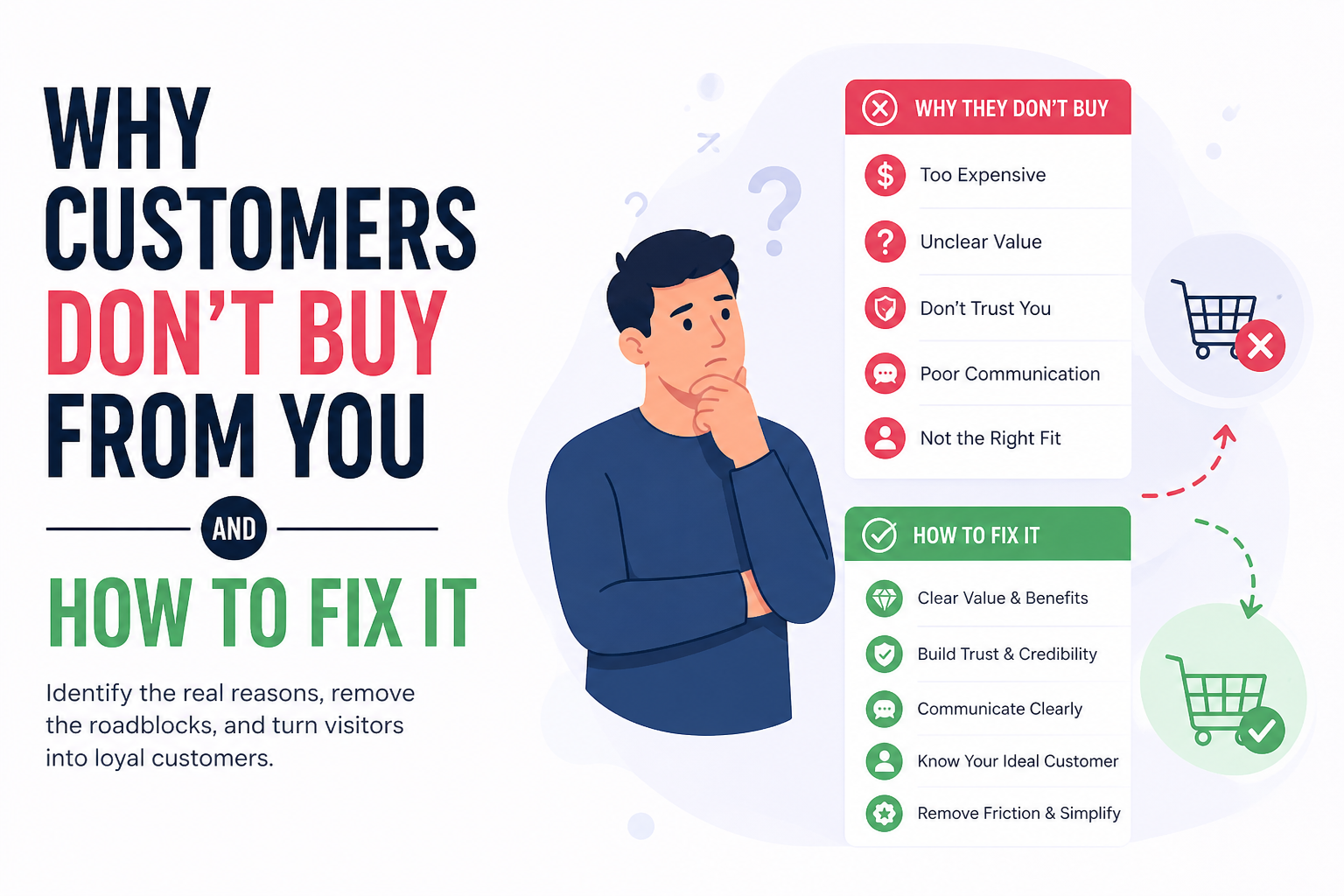
Why customers don’t buy from you and how to fix it
Your product or service is not bought: you do not understand this, because in your opinion ‘everything’ is correct. The good news: this does not have to be anything to do with your offer. However, there is a problem around your customer journey, also called the imaginary steps that potential customers go through to eventually make a final purchase. Not useful, but it can be repaired.
Successful selling starts with a good product ecosystem
You may be wondering: What is a product ecosystem? In marketing, this means the logical whole around products and steps that a customer goes through: from discovering your offer to the moment that the person comes back to you more often. So it is not about one product, but a series of products and contact moments that reinforce each other and logically connect: compare it with a path that a (potential) customer walks and goes to the final destination step by step.
All phases have their own purpose, but together they form one system that:
- Build confidence
- The threshold to buy is lowering Makes potential customers warm for your main product
- Customers let come back A product ecosystem is therefore a smart and logical route from small to large purchases that ensures that customers do not drop out, but come back more often. It provides rhythm and structure and makes your business scalable and profitable.
Visual representation of the product ecosystem
The 5 phases of a profitable product ecosystem
Each phase within this imaginary step-by-step plan, also called the customer journey, has its own goal: to bring (potential) customers to the next destination. So when a phase is missing or not logically connected, the customer journey falls apart. What exactly do these phases look like?
Phase 1: Introduction
This is the phase in which contacts discover you for the first time: maybe they have been following you for a while, do they recognize your brand or do they happen to run into you. What characterizes this phase is that you do not yet have data from these unknown contacts, but you are visible to them. In this phase, you want to build trust and recognition.
How you do this? Think of...
- Instagram/TikTok content
- Reels
- Reviews
- YouTube videos
- Blogs or podcasts
In phase 1, the goal is to stand out and arouse interest.
Phase 2: Lead Generation
In this phase you want to make those unknown contacts potential customers: the goal here is to find out their contact details. But, for nothing, the sun rises: you have to do something for this. In exchange for an e-mail address, you in turn share something of value: often this is in the form of a free giveaway, such as an e-book with tips or, for example, a discount code as a welcome.
Examples:
- Free recipe book
- Discount Code
- E-book with tips
In phase 2, your goal is to collect data and start a relationship. So be creative and think of a good reason why contacts want to leave their email address with you.
Phase 3: Lead product
Many entrepreneurs often have phase 1, 2 and 4: phase 3 is often missed while this is the step that connects everything: here you want to bridge the ‘black hole’ by turning potential customers (leads) warm for your main product. For this you work with the so-called lead product.
The lead product is accessible, affordable and intended to give someone a first experience with you: you want to give 100% for a perfect first impression. Super shame to leave this phase unused, because it is supposedly your hall to eventually let people walk into your living room.
This product does not have to be profitable either: this is purely about building trust, increasing your conversion and a beautiful cash flow.
The lead product is accessible, affordable and intended to give someone a first experience with you: you want to give 100% for a perfect first impression. Super shame to leave this phase unused, because it is supposedly your hall to eventually let people walk into your living room.
This product does not have to be profitable either: this is purely about building trust, increasing your conversion and a beautiful cash flow.
Examples:
- Tasting with discount
- Short mini course
The goal of phase 3: warming up potential customers and lowering the threshold by first offering a more low-threshold product.
Phase 4: Main product / Core product
The main product is what you want to make your money with: this shows that you have the solution to a certain problem or meet a certain customer desire. In this phase, it must also feel almost indispensable, which makes the customer inclined to respond to the offer today.
The goal of phase 4: increase your conversion to your main product or offer.
Phase 5: Customer product
When someone has bought from you and is very satisfied, this person often comes back to you to buy more: phase 5 ensures that customers stay with you longer and make repeat purchases more often. Here your goal is to increase your customer value. But, you also want to increase the value for the customer, for example by offering something extra.
Examples:
- Wine subscription after a restaurant visit
- Maintenance products or VIP collection
- 1-to-1 training after a course
Increase the goal of phase 5: customer value and create recurring revenue.
Why this system works
The product ecosystem therefore ensures that everything cooperates with each other and there is a logical structure in your customer journey.
- It makes your turnover predictable
- It prevents the 'black hole' between free value and your core product
- It warms up potential customers step by step
- It ensures repeat purchases and therefore a higher customer value
- It gives structure to your marketing, launches and content
When a customer journey makes sense and therefore right, people feel helped and understood without consciously asking for it. You remove the doubt, reduce possible thresholds and increase confidence.
Without a logical product ecosystem, your company will continue to run on chance, which can also be completely wrong due to the lack of purchases. With a beating ecosystem, it runs on strategy and one that you can optimize over and over again.
In Conclusion
With your offer, there is nothing wrong at all. But, is there something wrong with your product ecosystem and do you not have a correct customer journey? Then there is a good chance that your business will always linger in a negative spiral.
Therefore, make sure that each phase has one goal, offers a logical continuation to the next step and thus create a profitable model. And, be sure to give your creativity space, because it is precisely with unique ways that you can stand out to attract new contacts and transform them into returning customers, especially if you offer them the best experience.
Do you also want to set up successful customer journeys? Discover the power of Brownmailer with a free trial account !